

Restore Trust in Your Experiencd
Leave common fallacies behind - read science as unfinished

Trust in your Experience - navigate sovereignly through crises
Do you trust in your experience? Or do you often feel the need for a permission, affirmation or authority before you can accept what you actually already know? Would you rather trust a renowned authority or an admired teacher than your own mind?
In moments of weakness, uncertainty and crisis, we easily lose confidence in our own perceptions. Some may even wish to be someone else. Or we believe that others have better access to reality and truth. Doubt makes us question why we hold our own experience as less reliable. This is exaggerated? Think back to the time of Corona crisis when so much confusion and helplessness was around so many rivalising theories of origin of the pandemy.

Where does this susceptibility for toxic narratives come from?
We are living in a time when misinformation, manipulation, and polarising narratives spread at extraordinary speed. Yet this is not a new phenomenon. A century ago, societies were shaped by toxic narratives of racism and antisemitism. Two centuries ago, colonial ideologies justified the domination of peoples outside Europe. Earlier still, religious conflicts were fuelled by stories that divided humanity into opposing camps.
Perhaps the roots of such narratives reach much further back. Wherever human beings have faced fear, uncertainty, loss, and vulnerability, stories have emerged that promised certainty while often distorting reality.

Why Philosophy can help to Trust in your Experience
One of the enduring tasks of philosophy has been to help people distinguish between experience and the narratives imposed upon it. Today, that task feels more important than ever, because of the overwhelming mass or flood of information reaching us every hour.
The question is: how can we restore trust in our own experience without becoming naïve? How can we remain open to science and critical thinking while avoiding the trap of surrendering our own perception entirely to external authorities?
These questions are especially important for those who have historically been encouraged to doubt themselves. Women, minorities, and vulnerable people have often been told that their experience is unreliable and that others are better qualified to interpret reality for them.
A Case of Shattered Trust
Recently, I encountered a claim that deeply astonished me. A teacher stated that both dreams and waking consciousness are forms of illusion and that science has demonstrated this to be the case. The implication was that what we perceive as material reality is no more real than a dream.
This left me breathless, and I tried to find out what science she might be referring to, since there is no one and only science. Here is what I found out:
Scientific Findings and Exaggerations
Modern cognitive science has indeed produced fascinating theories about perception and consciousness.

The Interface Theory of Perception
For example, Donald Hoffman argues that evolution does not necessarily favour perceptions that represent reality accurately. Instead, evolution favours perceptions that help organisms survive. According to his Interface Theory of Perception, our perceptions function somewhat like the icons on a computer desktop: useful for navigation and enabling us to act rapidly but not necessarily revealing the underlying reality.
Consciousness as User Surface
In a similar way, Daniel Dennett has proposed that consciousness functions as a kind of user interface generated by the brain, allowing us to interact effectively with a complexity that remains largely hidden from awareness. And indeed, the capacity to reduce complexity is fantastic: Once you’ve learned to walk, you can do it without any decision making. Many skills get readily automated and available.
Brain-Oracle - Oracle-Brain
Anil Seth, working within the framework of predictive processing, describes perception as a "controlled hallucination." In his account, the brain continuously generates predictions about the world and adjusts them whenever incoming sensory information fails to match expectations. This invention of mother nature is highly energy saving, because we need only to be aware of what does not work in the present moment. I love this fallible oracle-brain when I get a new insight following the discovery of a beautiful novelty, and I damn it for a harsh correction, when I stumble over a stone.
Perception is more than Passive Recording
The three presented models deliver important scientific contributions. They challenge the old idea that perception is simply a passive recording device. They explain less about our capabilities for innovation and invention, while it shimmers through the veil.
I love this fallible oraclebrain, when I discover a wonderful novelty and gain a new insight - and I will damn this oracle when I stumble over a stone and experience a hard correction of my assumptions.

A Practical Example: Experience over Theory
Let us consider the sphere of working of the predictive brain through a simple example: A young lady with brown hair:
You know her for some time and your brain predicts successfully:
"The young woman has brown hair."
"Brown hair again."
"Still brown hair."
Then one day she appears with red hair.
The prediction fails. Now the model is updated from brown to red.
A few weeks later, she arrives blonde.
Will your brain do business as usual and update model red to blonde?
I guess it will do something completely different. Prediction transforms into curiosity and an attentive attitude. Or will prediction be substituted by disinterest?
My own puzzling tells me that the brain now goes a more complicated path. More parts and other contributors are involved. And I must ask:
Who is curious? Is the brain curious? Is curiosity itself curious?
Is it depending on the relationship between you and the young woman, whether curiosity will emerge or disinterest in hair colours?
How many persons or entities such as brain, eyes and senses and neurons are at work? As you see, there has meaning stepped forward onto the awareness stage, value as well.
Philosophy looks into Experience
At this point we move from neuroscience into philosophy.
The scientific theories describe mechanisms of experience. They explain how perception may be generated, organised, and refined. Yet they do not replace the experience itself.
No matter how sophisticated our theories become, a fundamental fact remains:
Someone is having the experience. This person is perceiving. Perhaps she is wondering. Probably she is curious. Someone is asking questions about consciousness itself.
This is where process philosophy offers a broader perspective. And I will ask philosophy about experience:
Experience as Centre of Process Thinking
Alfred North Whitehead argued that experience should not be treated as an accidental by-product of a fundamentally dead and meaningless universe. Instead, he proposed that experience—or what he called "prehension" (any kind of "feeling")—is a fundamental feature of reality.
For Whitehead, reality is not ultimately made of static things but of events, processes, relationships, and experiences. Matter itself is an abstraction derived from a deeper world of dynamic becoming.
Whether one agrees with Whitehead or not, his perspective reminds us of something important: every scientific model begins within experience.
Scientists observe experiences. They conduct experiments that are experienced. The analysed data are experienced. Theories they then formulate are experienced. All scientists move through multiple steps of experience. Therefore: Experience is not something that science can simply step outside of. It is the very ground upon which science stands. However, science needs abstraction, a reduction of complexity.

The Susceptibility to mistake Abstraction for Reality
Whitehead warned against what he called the fallacy of misplaced concreteness:fallacy of misplaced concretenessmistaking an abstraction for reality itself.
Scientific models are extraordinarily useful abstractions. But they remain models. And we, as the readers informed by secondary media most of the time are able to remain aware of this:
A map is not the landscape. Musical scores are not the music. Love is not experienced by studying a neurological model of love. And we do not experience the world when we learn a model of perception.
Difficulties in the way of "fallacy of misplaced concreteness" arise when we forget this distinction.
Get out of the Trap of Misplaced Concreteness
Although perception constructs, it remains our access to the real world.
Consciousness is well mediating, but not deceiving. Normally she reflects reality rather well.
The brain predicts in order to function in an economical way. The source of the predictions remains real. And the brain can learn and process critics. The world remains there, not the prejudice.
We are fortunate to live with a perception that is not a perfect mirror of reality. This does not change the real world into illusion.
Scientist know the model character of their theories. Helas, oftentimes, media transform the theories in simplified and captivating news.
Understand Science with Compassion
Therefore, do not fall in the trap of misplaced concreteness however beautiful an abstraction might see. You do note need to reject it. It calls you to understand science more deeply and compassionately, seeing the limits. And restore trust in the experience of your loved ones.
The sciences teach us a great deal about how perception works. Philosophy reminds us to ask what perception is for. The sciences explain mechanisms. Philosophy explores meaning. The sciences illuminate the parts. Philosophy considers the whole.
Experience and perception are living, relational processes through which we participate in an unfolding world. And for that reason, trust in experience remains not only possible, but essential. The task is not to abandon experience. The task is to understand it more deeply. Because our experience is an actual, relational event that participates in the creative unfolding of the cosmos. Our perceptions do not merely hide reality; they actively constitute it in the present moment. And this is true for each one of us being lucky enough to have a working brain, nervous system and body and space to breathe and to move.
Experience needs one and another one
A happy coincidence and patient reading braought me to the following quotation on Logos and Eros, see it as Yin and Yang, if you prefer:
„“Logos is not a cold engineer mind designing from a distance. From Heraclitus and Philo through Plotinus and Maximus the Confessor, Logos is described as fluid, living, relational, ever-new, and indeed, as carnal. There is good reason Chinese Bibles render Logos as Tao. The Logos I want to resuscitate is not the frozen blueprint but the erotic axiology of possibility itself. Logos so understood is not the enemy of the adjacent possible but its condition of possibility: the grading of relevance by which the indefinite becomes, not a set of pre-determined variables, but a relevant field of viable next steps. Eros without Logos is selfish yearning; Logos without Eros is dead deduction; birthing the Living Word has always required their marriage.”.“
Matthew David Segal, Substack, July 7, 2026: Footnotes2Plato
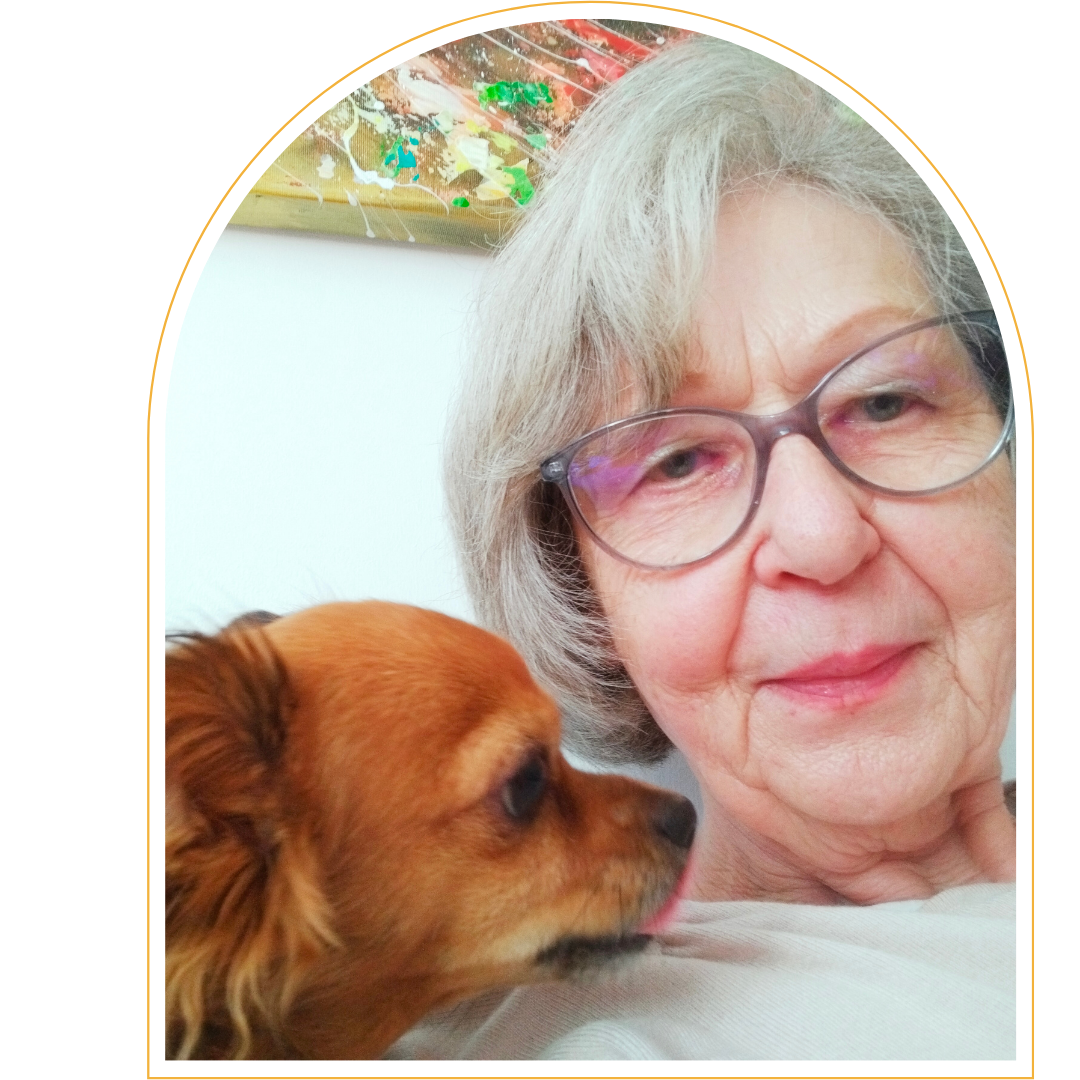
Confidence and Self-Assertiveness"
Hi, I am Ingrid Drafta
I am Ingrid and in my work I combine depth psychological Coaching (learned at Jungian Coaching School) with neo-shamanic meditations and talking practices which I studied at the Four Winds Society and the She Rising Academy. As you see here in the texts I like to combine Science and Soul Wisdom.
In our initial session you will gain clarity about how to unfold by my Coaching Program. You will get a first insight into your own emotional place now, and orientation for the development that you desire. This initial session is free, confidential and non-binding.
Start with an initial coaching session.
Blossomed: What Clients Appreciate
There will be joy and selfconfidence in your life
My clients and fellow travelers in the Talking Circles and meditations have become calmer. Their emotions flow in greater harmony. Because we have learned to find new direction through our feelings with compassion, we no longer allow ourselves to be thrown off course by the moods and whims of others. We feel freer and choose our relationships more carefully. We begin to choose—and to become—the women we want to be.
“More than anything, I value the sense of peace I have found. I live without constant anxiety and know that I can trust myself. I no longer let myself be infected by haste and panic; instead, I set healthy boundaries. As a result, my life has become more precious.”
I continue to feel compassion for others, but I don't lose myself in it. I neither fall into co-dependence nor take on someone else's feelings. My conscience has become calm because I have learned to deal with my emotions in an accepting and transformative way.
Today I treat myself to what I can afford. Give and take are in balance. I bought a horse and moved to the sea. I made dreams come true. And I have found my purpose in this life. This is simply wonderful.
Get in Contact with me!

Phone
+49 (0) 177-3333661

